Have you ever noticed how different words can create different feelings inside you?
For example, saying:
“I am broken”
feels very different from saying:
“Something in me is hurting and needs care.”
The situation may not have changed, but the inner experience changes. One sentence can close something down. Another can open a small doorway.
This is the meaning behind the phrase:
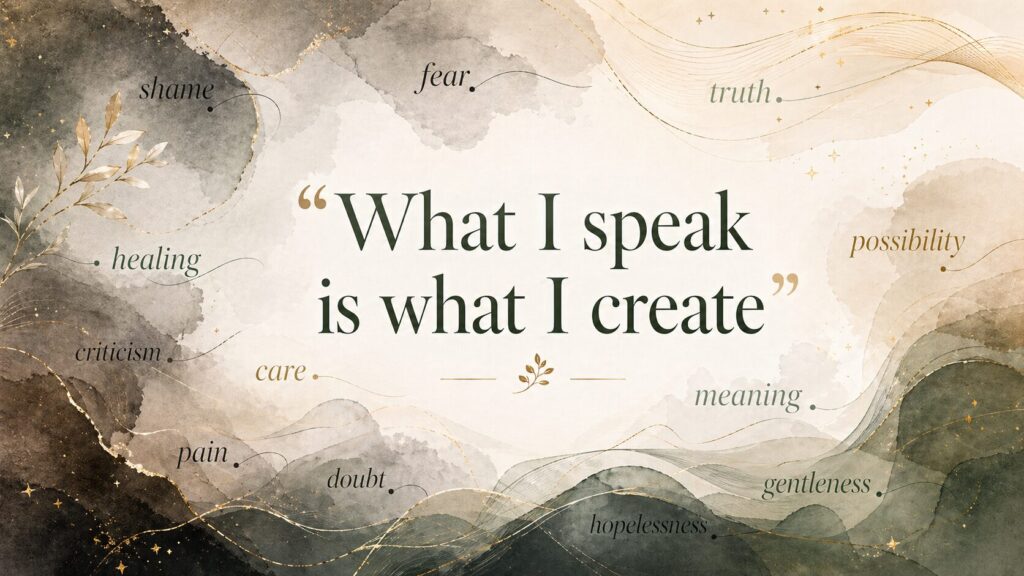
“What I speak is what I create.”
It does not mean that every word magically creates reality in a frightening or literal way. It does not mean we must become anxious about saying the “wrong” thing. Instead, it invites us to notice how our language shapes our inner world, our emotions, our relationships, and even the possibilities we can imagine for ourselves.
Words Can Become Inner Suggestions
In hypnotherapy, we understand that the mind is deeply responsive to suggestion. These suggestions do not only come from other people. Very often, they come from the words we repeatedly say to ourselves.
If a person often says:
“I can’t cope.”
“I always fail.”
“Nothing ever works for me.”
“I am too damaged.”
These words may begin to act like quiet instructions to the unconscious mind.
Over time, the mind may start looking for evidence that confirms them. The body may respond with heaviness, anxiety, shutdown, or hopelessness. The person may begin to feel trapped inside a story that has been repeated for many years.
This is not because the person is weak. It is because the mind learns through repetition.
A Softer Way to Speak to Yourself
The good news is that we can begin to change the way we speak to ourselves — gently, not forcefully.
Instead of saying:
“I am useless.”
we might say:
“I am feeling discouraged today.”
Instead of:
“I can’t do anything right.”
we might say:
“Something in me is afraid I will fail.”
Instead of:
“I am broken.”
we might say:
“I have been hurt, and I am still healing.”
These small changes matter. They create a little more space. They help us move from self-attack into self-understanding.
And that space is often where healing begins.
Words Shape How We Meet Ourselves
The way we name our experience influences how we relate to it.
If we call anxiety “weakness,” we may feel ashamed of it.
If we call anxiety “a protective response,” we may become curious about what it is trying to protect us from.
If we call anger “bad,” we may push it away.
If we call anger “a signal that a boundary may have been crossed,” we may learn to listen more wisely.
This does not mean every feeling is always correct in what it tells us. But every feeling may carry some meaning, memory, or need that deserves to be understood.
Language Can Open or Close Possibility
When we speak harshly to ourselves, our inner world often becomes smaller.
Words like “always,” “never,” “hopeless,” and “impossible” can make life feel like a locked room.
But gentler, more curious language can open the room slightly:
“What else might be possible?”
“What is this feeling trying to tell me?”
“What part of me needs support right now?”
“Could this be an old wound speaking?”
These questions do not deny pain. They simply stop pain from becoming the whole story.
In Therapy, Words Can Become a Pathway
In psychodynamic hypnotherapy, we may explore not only what a person says, but what deeper beliefs may live underneath those words.
For example, if someone often says:
“I don’t matter.”
we may gently explore where that belief came from.
Was it learned in childhood?
Was it created through rejection, criticism, neglect, or emotional pain?
Was it once a way to make sense of something unbearable?
When these old beliefs are brought into awareness, they can begin to soften. The person may discover that the words they have been living under were not absolute truths. They were old conclusions formed from old pain.
And what was learned can often be unlearned.
A Gentle Practice
You may like to try this simple exercise.
For one day, gently notice the words you use about yourself.
Not to criticise yourself.
Not to police every thought.
Just to notice.
When you catch a harsh sentence, ask yourself:
“Is there a kinder and more accurate way to say this?”
For example:
“I am lazy”
could become
“I am tired, overwhelmed, or resisting something for a reason.”
“I am a failure”
could become
“I am disappointed, but I am still learning.”
“I can’t cope”
could become
“I am struggling right now, and I may need support.”
This is not pretending everything is fine. It is speaking to yourself in a way that gives your nervous system a little more safety.
Final Thought
Words are powerful. They can become walls, or they can become doors.
The way we speak to ourselves does not create everything in life, but it does influence how we experience life. Our words can deepen shame, or they can invite compassion. They can keep old wounds alive, or they can begin to make space for healing.
Perhaps a gentler version of the phrase is this:
“The words I speak help shape the world I live in.”
And when we learn to speak to ourselves with more kindness, curiosity, and truth, we may begin to create an inner world where healing feels more possible.