Fears and Phobias: When the Past Is Still Trying to Protect Us
For many years, I believed my fears were flaws.
I told myself I was too sensitive, too anxious, too reactive. I wondered why certain situations filled me with dread while others seemed to cope just fine. Why my body would tense, my breath shorten, my thoughts race—often without any obvious danger present.
What I came to understand, both personally and professionally, is this:
many fears and phobias are not irrational at all. They are memories. They are protection strategies shaped by past experiences—often traumatic ones.
When we think of trauma, we often imagine dramatic events we can clearly remember. But trauma doesn’t always announce itself that way. Sometimes it happens early. Sometimes it happens quietly. Sometimes it happens when we had no power, no words, and no way to escape.
The nervous system remembers what the mind may not.
A fear of driving, flying, medical procedures, closed spaces, social situations, intimacy, or loss of control often isn’t “about” the present moment at all. It’s about a time when the body learned that something was unsafe—and never fully learned that the danger had passed.
From the outside, a phobia may look exaggerated. From the inside, it feels very real. The heart races. Muscles tighten. The urge to escape becomes overwhelming. This isn’t weakness. It’s the survival system doing exactly what it was trained to do.

One of the most important shifts in my own healing was this:
I stopped asking, “What’s wrong with me?”
and started asking, “What happened to me?”
Fear often develops as a loyal protector. If something once overwhelmed you—emotionally or physically—your system may decide: Never again.
So it stays alert. It anticipates. It avoids. It reacts quickly.
In trauma, fear is rarely the problem. It is the solution the nervous system found at the time.
Phobias, in this sense, are frozen protection. They are outdated alarms that were never gently turned off.
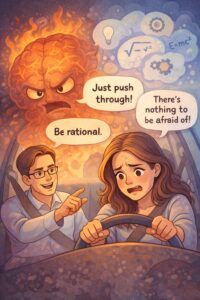
Many people try to overcome fears by forcing themselves through them. “Just push through.” “There’s nothing to be afraid of.” “Be rational.”
And yet, fear persists.
That’s because trauma is not stored in logic. It’s stored in the body, in implicit memory, in emotional and sensory networks. You cannot reason your way out of a fear that wasn’t created by reason in the first place.
This is why people often feel frustrated or ashamed when exposure alone doesn’t help—or when they “know” they’re safe but don’t feel safe.
Healing requires working with the part of the system that learned fear in the first place.
In my work, I approach fears and phobias not as enemies to defeat, but as messengers to listen to.
Instead of asking someone to relive trauma, we create safety first. We build inner stability. We help the nervous system experience calm, choice, and control—often for the first time.
Through approaches such as hypnotherapy, trauma-informed techniques, and gentle subconscious work, it becomes possible to:
uncover the original meaning behind the fear
release the emotional charge without re-traumatisation
update the nervous system to the present
and restore a sense of inner safety and self-trust
When fear feels understood rather than fought, it often softens naturally.
This is something I want to say clearly:
If you live with fears or phobias, it does not mean you are weak, defective, or failing at life.
It means your system learned something important at a time when it had to.
And systems can learn again.
Healing is not about erasing the past. It’s about helping the body understand that the past is over.
When safety becomes an inner experience—not something you have to constantly search for—fear no longer needs to shout.
It can finally rest.
HYPNOTHERAPY & COACHING WITH GINTA
REWRITE YOUR STORY AND AWAKEN YOUR BEST SELF WITH HYPNOSIS